
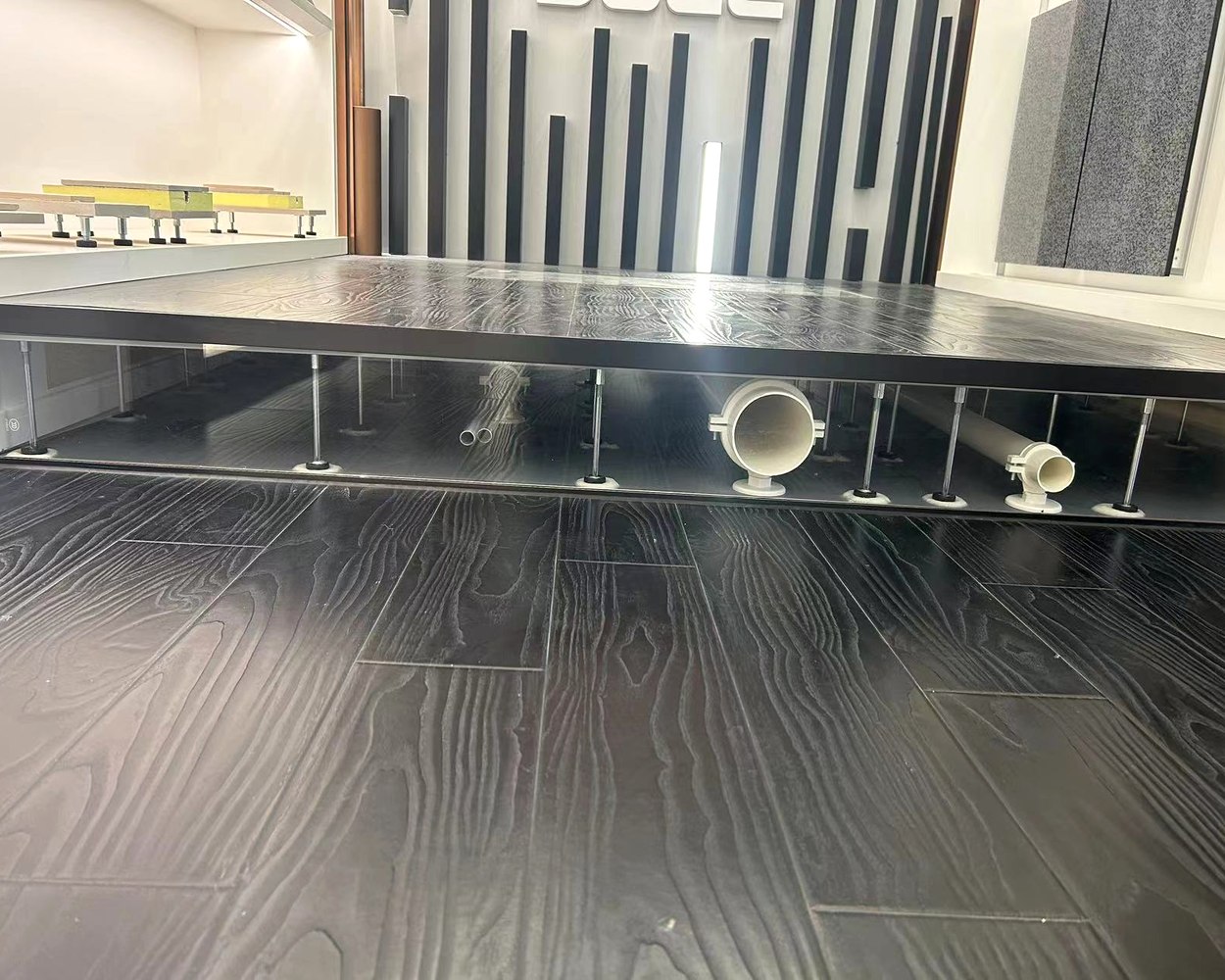
A dry raised floor is not difficult to install, but it is unforgiving of sequence. The nine steps below come from our site method statement; skip one and the error shows up at handover as a hollow panel or a step in the floor.
1. Set the datum. Snap a reference line around the perimeter walls at the finished floor level. Every later measurement refers back to this line. 2. Check the base panels. Confirm the pre-drilled openings against the panel layout drawing before anything goes down. 3. Clear the floor and mark out. With services already in the slab, mark every bolt position and check for clashes — this is the step that most often gets rushed, and it is the one that causes rework.
4. Fit the nuts into the base panel. 5. Screw in the threaded rods to form the support modules, and set each one to the design height. 6. Place the modules, level them to the datum line, and wedge them against the perimeter walls with timber wedges.
7. Pour the adhesive through the bore of each bolt — about 3–5 ml per bolt. 8. Leave it at ambient temperature, around 25 °C, for two hours before the next operation. The adhesive is what locks the bolt to the panel; loading it early is the most common cause of a support that settles later.
9. Lay the balance board. Stagger it against the support modules, and fix it with self-drilling screws at 300 mm centres. Then clean the surface and hand over for inspection.
Materials for a typical area: base panels and support bolts per the layout, balance boards, 400 ml of two-part adhesive (about seven cartridges), self-drilling screws, and timber wedges. Tools are ordinary: a drill with a 15 mm bit, a 5 mm hex key, a 15 mm hole saw, an angle grinder or table saw for cutting panels, a laser level, a chalk line, and the usual site protection.